"UL cable" does not describe one specific type of cable. It generally means a wire or cable evaluated by UL Solutions under an applicable certification program, standard or product category. A UL Listed cable is typically evaluated for a defined end use or installation, while UL Recognized Components, including many AWM constructions, are designed to become part of another product.
This article breaks down what UL cable certification actually means, how Listed and Recognized designations differ in practice, which standards govern each category, and how to verify a supplier's UL certification before specifying a cable for your project.
UL Solutions is an independent testing and certification organization. When a product carries an authorized UL Mark, representative samples have been evaluated against requirements in the applicable standard. Certified products are also subject to UL's Follow-Up Service, which includes periodic checks at manufacturing facilities.
UL's Wire and Cable Application Guide states that the UL Mark on the coil, reel, flange or box is the primary means of identifying cable covered by UL certification and Follow-Up Service. UL letters or symbols printed on the cable itself are supplemental markings.
This is an important point for buyers. When checking a shipment, do not inspect only the cable jacket. The reel or package label and the certification record matter as well.
| UL term | What it generally means | Typical cable context | What buyers should check |
| UL Listed | A complete product has been evaluated for its intended use under an applicable UL product category | Communications cable, fire alarm cable, building wire and other finished cable types | Cable type, intended use, rating and exact Listing scope |
| UL Recognized Component | A component has been evaluated for use within another product or system, subject to defined conditions | Appliance Wiring Material (AWM), internal wiring and component wiring | Whether the intended equipment application matches the component conditions |
| UL Verified | A specified performance claim has been independently verified | Data transmission performance of communications cable | Exactly which performance characteristic or category was verified |
| UL Certified | A broader term used across UL certification programs and enhanced UL Marks | May encompass Listings or other certifications depending on the mark and record | Product iQ record, geography and certification scope |
One common mistake is assuming that UL Recognized AWM is automatically equivalent to UL Listed building cable.
UL 758 states that AWM is primarily intended for factory-installed wiring inside equipment, external interconnecting wiring for appliances, or use as a component in another cable. It is not intended to replace NEC building-wire types outside the conditions permitted for the end product.
So when a supplier says “UL cable,” the next question should always be: Listed or Recognized—and to which standard?
There is no single “UL cable standard.” Different cable families are evaluated under different standards.
| Standard | Main cable/application area | Useful buyer takeaway |
| UL 444 | Communications cables for voice, data and audio systems | Includes communications cable types used in building installations |
| UL 1424 | Power-limited fire alarm cable | Covers FPLP, FPLR and FPL cable |
| UL 758 | Appliance Wiring Material (AWM) | Primarily component and equipment wiring rather than general NEC building wiring |
| UL 83 | Thermoplastic-insulated wire and cable | Covers 600 V single-conductor thermoplastic-insulated products |
| UL 44 | Thermoset-insulated wire and cable | Covers products rated 600 V, 1,000 V, 2,000 V and 5,000 V |
| UL 2556 | Wire and cable test methods | Defines test apparatus, methods and calculations used by wire and cable standards |
A cable jacket can carry a considerable amount of information. Depending on the cable type and certification category, a typical print legend may include:
manufacturer or brand + cable type/category + conductor size + shielding construction + installation rating + temperature or material information + certification markings + production or length information.
The exact authorized marking differs among cable categories, so buyers should not expect every UL cable to use the same print format.
For communications cables, common installation markings include CMP, CMR and CM. For power-limited fire alarm cable, the corresponding designations include FPLP, FPLR and FPL.
The important part is not simply finding the letters “UL.” A proper compliance check combines the cable legend with the reel or carton label and the appropriate UL certification record. UL itself recommends reviewing product, tag and carton markings together where necessary to determine suitability for an installation.
The letters following a communications cable designation matter because they indicate the installation category for which the cable has been evaluated.
| Marking | Typical installation category | Practical meaning |
| CMP | Plenum | Designed for spaces used for environmental air where the applicable code requires plenum-rated communications cable |
| CMR | Riser | Designed for vertical runs and riser applications between floors |
| CM | General purpose | Used for permitted general-purpose communications cable installations |
Do not select one solely because it "sounds more fire resistant." The correct cable is determined by the installation route, applicable electrical code, project specification and the authority having jurisdiction (AHJ).
The same installation logic applies to fire alarm cable, but the markings are different.
According to UL 1424:
| Marking | Defined use |
| FPLP | Plenum cable |
| FPLR | Riser cable |
| FPL | Cable for uses other than plenum and riser, including permitted general and tray applications |
UL 1424 applies different flame-test requirements to these cable categories. For example, an FPLP cable tested for plenum use must exhibit a maximum flame-propagation distance of 5 ft (152 cm) or less. The peak optical density of smoke must be 0.50 or less, and the average optical density must be 0.15 or less. For FPL cable, UL 1424 specifies a 70,000 Btu/h (20.5 kW) vertical-tray flame-test exposure.
Not in the simple sense that every cable sold in the United States must carry the UL brand.
UL LLC is one of the Nationally Recognized Testing Laboratories (NRTLs) recognized by the U.S. Occupational Safety and Health Administration. Intertek and other organizations also appear on OSHA's current NRTL list.
What matters for a project is whether the cable satisfies the certification, listing and installation requirements applicable to that product and installation.
Depending on the project, those requirements can come from the NEC, the locally adopted electrical code, the project specification, the customer or the AHJ.
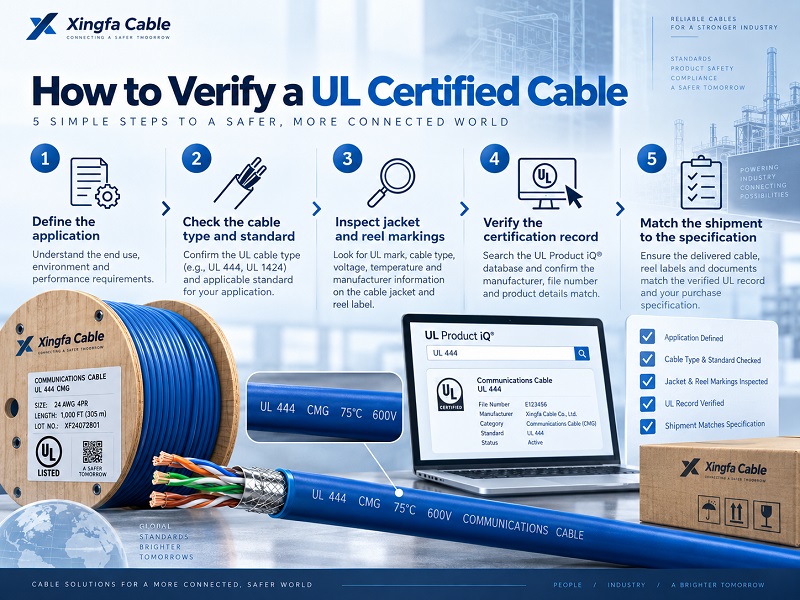
For importers and project buyers, verification should happen before the purchase order—not after the shipment reaches site.
A practical five-step process is:
Define the application first.
Determine whether the cable will be installed in a plenum, riser, general area, fire alarm circuit, communications network, equipment enclosure or another application.
Ask for the exact standard and cable designation.
“UL certified” is too general. Ask for information such as UL 444 / CMR, UL 1424 / FPLR, or UL 758 / AWM Style as applicable.
Check the reel, coil or carton UL Mark.
Do not rely only on a UL symbol printed on the jacket. UL specifically identifies the complete Mark on the packaging or reel as the key means of identifying covered wire and cable.
Verify the certification record.
Search UL Product iQ and compare the company name, product category, file number, model/type and certification geography with what the supplier is offering.
Match the shipment to the certification.
The jacket legend, packaging label, specification sheet and certification scope should describe the product you actually receive.
This process also helps detect a common procurement problem: a genuine UL file number being presented for a product that is not actually included in that file's certified scope.
Understanding what a UL Mark does not prove is just as important as knowing what it does prove.
A ul certified cable manufacturer does not automatically mean every cable made by that factory is UL certified. Certification applies to products and constructions within a defined certification scope.
A UL file number does not automatically cover every product in a supplier's catalog. Buyers should match the exact product category and model or construction to the certification record.
"UL"printed on the cable jacket alone is not complete proof of certification. The accompanying UL Mark and certification information are essential.
A safety Listing does not automatically prove every performance claim. For data cables, transmission-performance verification can be a separate consideration.
A U.S. UL Mark does not automatically mean Canadian certification. UL distinguishes between products Listed to U.S. requirements, products carrying a UL Mark for Canada, and products carrying a combined Canada/U.S. Mark.
Hangzhou Xingfa Technology manufactures UL-certified cable products across more than one cable category.
For communications cable, Xingfa holds UL File E472210. The certification covers communications cable classifications including CMX, CM and CMR under UL 444, providing buyers with a specific file number that can be checked against UL certification records.
Xingfa's product range also includes UL-certified LAN cable options. Depending on the product series and construction, available categories include CAT5E, CAT6, CAT6A and other network cable configurations. Fire alarm cable is another major UL-certified product group, with UL 1424 FPL, FPLR and FPLP constructions available in shielded and unshielded versions.
Because certification scope differs by cable family and construction, buyers should verify the UL information for the specific product being quoted.
When requesting a quotation from Xingfa, it is useful to provide:
cable application;
required UL designation or installation rating;
conductor size and construction;
shielding requirement;
installation environment; and
estimated order quantity.
Xingfa can then match the requirement to an appropriate cable construction and provide the relevant certification information for verification.
A UL cable is a cable evaluated under an applicable UL Solutions certification program. The term does not identify one specific construction, so the relevant UL standard, cable type and installation rating still need to be confirmed.
UL Listed generally applies to finished products evaluated for a defined intended use. UL Recognized Component certification is commonly used for components incorporated into equipment or another finished product. UL 758 AWM is a common example in the wire and cable industry.
No. Requirements depend on the product, application, adopted code, project specification and AHJ. UL is also not the only OSHA-recognized NRTL. The important point is whether the exact cable satisfies the approval requirements for the project.
Check the cable marking and the complete certification identification on the reel or packaging, then verify the manufacturer, file number and product category through UL Product iQ. Make sure the record actually covers the product being offered.
CMP is intended for plenum applications, CMR for riser applications and CM for permitted general-purpose communications wiring. Selection should be based on the cable route and applicable installation requirements.
Under UL 1424, FPLP is intended for plenum applications, FPLR for riser applications and FPL for permitted general-purpose applications outside plenum and riser spaces. The classifications have different fire-performance requirements.