Shielded fire alarm cable adds a foil or braided metallic layer to reduce electromagnetic interference (EMI), while unshielded cable has no metallic screen and is generally simpler to install and terminate. Shielding is useful near motors, elevators, VFDs, power circuits, and other significant EMI sources, but it is not automatically the better choice for every system.
Whether to use shielded or unshielded cable depends on the fire alarm equipment, circuit design, and installation environment. Shielding is separate from the fire rating: both types can be manufactured as FPL, FPLR, or FPLP under UL 1424. Xingfa supplies both shielded and unshielded fire alarm cable for different project requirements.
| Factor | Shielded Fire Alarm Cable | Unshielded Fire Alarm Cable |
| EMI protection | Higher; metallic shield helps reduce external electromagnetic interference | No dedicated metallic EMI shield |
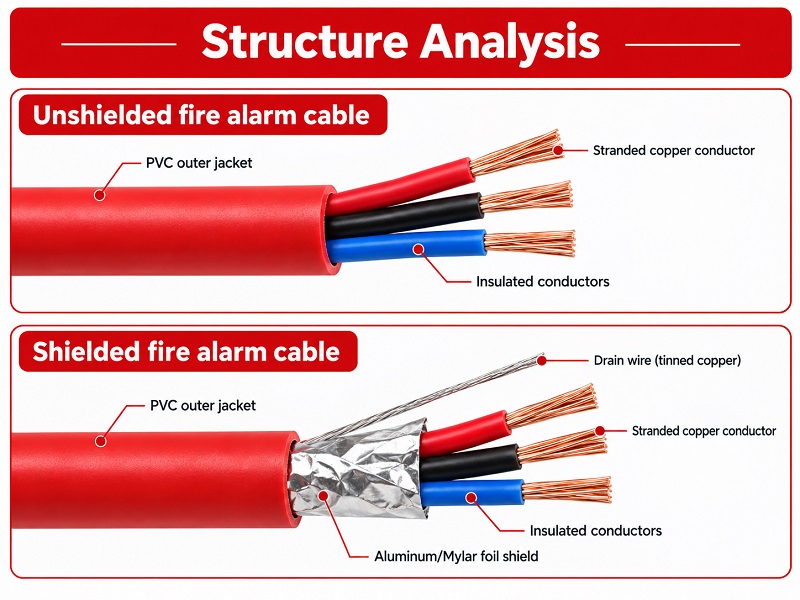
| Typical construction | Conductors + insulation + foil/braid shield + drain wire + jacket | Conductors + insulation + jacket |
| Best fit | When specified by the fire alarm equipment manufacturer or where EMI is a design concern | When the equipment permits it and the electrical environment does not require additional shielding |
| Termination | Requires attention to shield/drain-wire termination | Simpler termination |
| Cable diameter | Often slightly larger for an equivalent conductor construction | Usually simpler and more compact |
| Material cost | Usually higher | Usually lower |
| Installation labor | Can be higher because the shield and drain wire must be handled correctly | Generally faster to prepare and terminate |
| Fire rating | Can be FPL, FPLR or FPLP | Can also be FPL, FPLR or FPLP |
| Is it automatically better? | No | No |
| First selection rule | Follow the panel/system manufacturer's wiring requirements | Follow the panel/system manufacturer's wiring requirements |
Shielded fire alarm cable includes a conductive layer around the insulated conductors, typically an aluminum/polyester foil or, in some designs, a metallic braid. Foil-shielded constructions commonly include a drain wire to simplify shield termination.
The shield does not change whether the cable is FPL, FPLR, or FPLP. Its job is different: to reduce electromagnetic interference reaching the signal conductors.
Shielded cable is most relevant when the fire alarm system requires it or when the cable route is exposed to significant electrical noise from equipment such as motors, VFDs, elevators, transformers, or high-current circuits.
Unshielded fire alarm cable has no foil or braided metallic screen around the conductor assembly. This generally makes the cable simpler to manufacture, prepare, and terminate.
That does not make it a lower-grade option.
Many fire alarm systems are designed to operate with unshielded cable, including circuits that use twisted conductors to help control noise. Where the equipment manufacturer permits unshielded wiring and the cable route does not present a significant EMI concern, adding a shield may provide little practical benefit.
This distinction is important when specifying fire alarm cable.
Shielded or unshielded describes the cable's electromagnetic shielding construction.
FPL, FPLR, and FPLP describe fire-alarm cable installation classifications under UL 1424.
The current UL 1424 scope defines:
FPLP for plenum applications;
FPLR for riser applications;
FPL for applications other than plenum and riser, including permitted general and tray use.
The same standard separately states that cable containing one or more electromagnetic shields may be identified as “shielded.”
That means all of the following combinations are possible:
shielded FPL;
unshielded FPL;
shielded FPLR;
unshielded FPLR;
shielded FPLP;
unshielded FPLP.
UL 1424 also gives useful context for these ratings. Cables within its scope are rated 300 V, although that voltage is not marked on the cable. FPLP cable evaluated for plenum use must limit flame propagation to 5 ft (152 cm), with peak smoke optical density no greater than 0.50 and average optical density no greater than 0.15. FPL cable is subject to a 70,000 Btu/h (20.5 kW) vertical-tray flame test.
Those requirements concern fire performance and installation suitability. They do not tell you whether a particular fire alarm circuit needs an EMI shield.
Shielding deserves serious consideration when one or more of the following conditions apply.
1. The fire alarm equipment requires it
If the control panel or system manufacturer's manual specifies twisted shielded pair, use the specified cable construction. Matching only the AWG and fire rating is not enough.
2. The cable route passes through an electrically noisy environment
Shielding may be useful where signal wiring runs near equipment capable of producing electromagnetic interference, such as:
motors;
variable-frequency drives;
elevator machinery;
transformers;
switchgear;
high-current conductors;
industrial equipment.
The presence of an EMI source does not automatically determine the cable, but it is a reason to review shielding requirements carefully.
3. The project specification calls for shielded cable
Consultants, system designers, or equipment manufacturers may specify shielding for a particular circuit or environment.
If the project documents call for shielded FPLR, substituting unshielded FPLR simply because both carry the same fire classification changes the electrical construction of the specified cable.
Unshielded cable is appropriate when the system manufacturer permits or recommends it and additional EMI shielding is unnecessary.
Common reasons include:
the panel manual specifies twisted unshielded pair;
the route has no unusual EMI concern;
shielding adds no system-level benefit;
the installation benefits from simpler termination;
project cost needs to be controlled without departing from the approved wiring method.
A good RFQ reduces the chance of receiving a cable that technically resembles the specification but does not fit the actual system.
Include:
Fire alarm equipment or panel
Give the manufacturer and model when available, especially for addressable systems.
Circuit type
State whether the cable is for an SLC, IDC, NAC, control circuit or another connection.
Fire rating
Specify FPL, FPLR or FPLP as required by the installation.
Shield requirement
State shielded or unshielded rather than leaving the supplier to infer it.
Conductor construction
Include AWG, number of conductors and solid or stranded conductor.
Circuit length
For long addressable loops, this can matter as much as AWG.
Electrical limits
If the panel manual provides maximum resistance or capacitance, include those values in the technical review.
Certification requirements
Ask for documentation covering the actual construction being purchased.
Buyers comparing fire alarm cable manufacturers should confirm these details before comparing quotations solely on cable diameter or price.
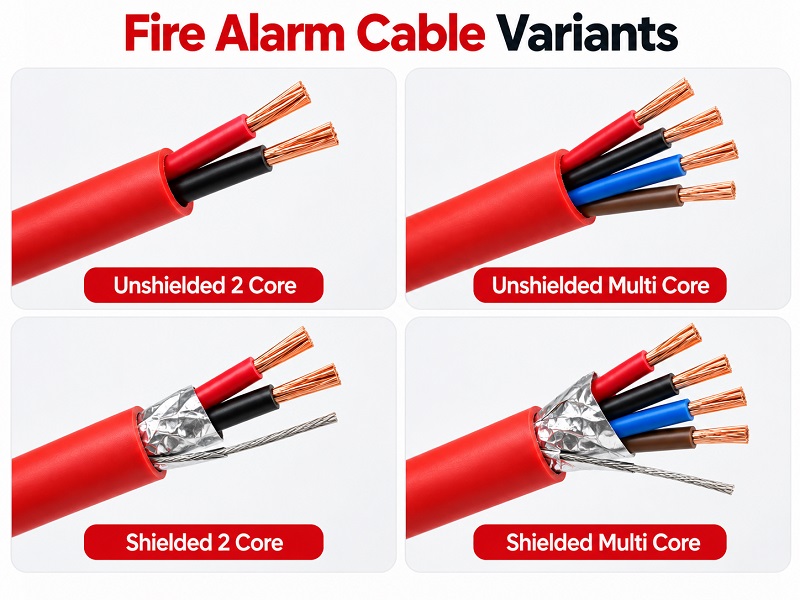
At Xingfa, we manufacture both shielded and unshielded fire alarm cables, including FPL, FPLR, and FPLP options in different conductor sizes, core counts, and shield configurations for different installation requirements.
When customers ask us whether they should choose shielded or unshielded cable, we normally start with the system requirements rather than the cable itself. The panel model, circuit type, installation route, required fire rating, cable length, and surrounding electrical environment are all useful when narrowing the specification. If shielding is required, we also need to know whether the project specifies a particular shield construction or drain-wire arrangement.
For buyers comparing fire alarm cable manufacturers, we recommend sending as much project information as possible with the enquiry:
panel or system model, circuit type, FPL/FPLR/FPLP rating, AWG, number of conductors, solid or stranded conductor, shield requirement, expected run length, packing length, quantity, and destination market.
If you are not sure whether the project needs shielded or unshielded cable, send us the fire alarm system information and installation conditions first.
Not always. Use shielded cable when the fire alarm equipment manufacturer or project specification requires it, or when the system design calls for shielding because of electromagnetic interference. Some panels specifically recommend twisted unshielded pair, so the equipment manual should be checked first.
No. Shielded cable provides an additional EMI-control layer, but that does not make it universally better. A system designed for unshielded cable may have different capacitance, resistance and maximum-distance requirements than one designed for shielded cable.
Shielded cable adds a conductive foil, braid or other metallic screen around the insulated conductors, usually with a drain wire. Unshielded cable does not. The shield is intended to reduce electromagnetic interference; it does not determine whether the cable is FPL, FPLR or FPLP.
No. FPLP means plenum-rated power-limited fire alarm cable. Shielding is a separate construction choice. Both shielded and unshielded FPLP cable are available. UL 1424 treats the FPLP/FPLR/FPL classification and electromagnetic shielding as separate characteristics.
Do not apply a universal grounding rule. Shield and drain-wire termination depends on the fire alarm equipment and wiring configuration. Manufacturer manuals may specify grounding, isolation, floating shield segments or particular termination points. Follow the wiring instructions for the exact control panel.
The choice between shielded and unshielded fire alarm cable should start with the system, not with the assumption that more shielding means better performance.
Use shielded cable when the equipment specification or electrical environment calls for it. Use unshielded cable when the fire alarm system is designed for it and additional shielding is unnecessary. Then select the appropriate FPL, FPLR or FPLP rating based on the installation pathway.