As businesses and data centers demand faster data transmission, 10 Gigabit Ethernet (10GbE) has become a key networking technology. It enables data transfer speeds of up to 10 Gbps, supporting bandwidth-intensive applications such as cloud computing, large-scale data storage, and high-definition video streaming. However, achieving reliable 10GbE performance requires the right cabling infrastructure. Choosing appropriate Ethernet cables and understanding their technical requirements are essential for ensuring stable, high-speed network connectivity.
10 Gigabit Ethernet, often referred to as 10GbE or 10GBASE-T, is a networking standard capable of delivering data transfer rates up to 10 Gbps over copper or fiber connections. Compared with traditional Gigabit Ethernet (1 Gbps), it offers significantly higher bandwidth and lower latency, making it ideal for modern enterprise networks and data centers.
However, high-speed transmission also places greater demands on the physical layer of the network. The cable must support higher frequencies, minimize signal interference, and maintain stable performance across the required distance.
Ethernet cables are categorized according to their bandwidth capacity and performance characteristics. For 10 Gigabit Ethernet, several cable categories can be used, but their supported distances and reliability vary.
Category 6 cables were originally designed for 1 Gbps networks with a bandwidth of 250 MHz. Although Cat6 can technically support 10GbE, its performance is limited by distance. Typically, Cat6 supports 10 Gbps only up to 37–55 meters, depending on environmental conditions and interference levels. Because of this limitation, Cat6 is generally suitable only for short runs, such as within a single equipment room or server rack.
Category 6A (Augmented Category 6) is widely recognized as the industry-recommended standard for 10GbE deployments. With a bandwidth of 500 MHz, Cat6A cables can deliver stable 10 Gbps performance across the full Ethernet channel length of 100 meters (328 feet). Cat6A cable features improved insulation, tighter twists, and enhanced shielding options that reduce alien crosstalk—a major challenge in high-speed networking environments.
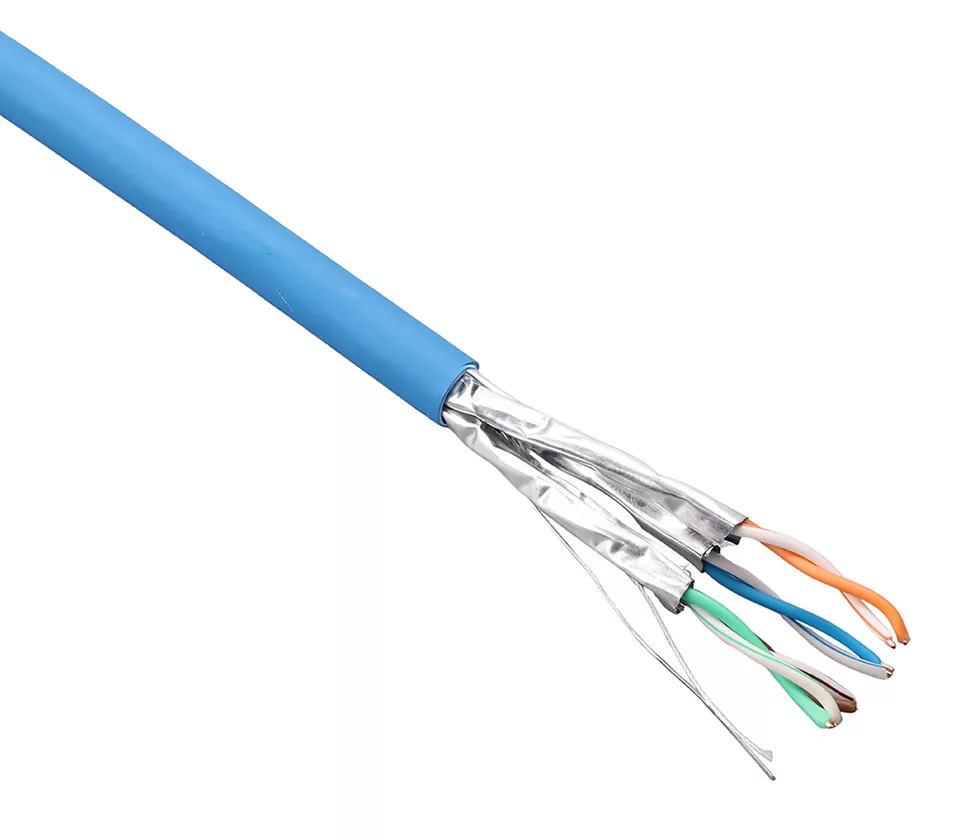
Higher-category cables such as Cat7 and Cat8 also support high-speed transmission.
Cat7 supports up to 10 Gbps at frequencies up to 600 MHz and offers strong shielding against electromagnetic interference (EMI).
Cat8 is designed for extremely high speeds (up to 40 Gbps) but over shorter distances, typically 30 meters, making it suitable mainly for data center switch-to-server connections.
For most enterprise installations, Cat6A remains the best balance of cost, performance, and compatibility.
Another critical requirement for 10 Gigabit Ethernet cabling is maximum transmission distance. According to Ethernet standards, the maximum length for copper Ethernet channels is 100 meters, which includes 90 meters of permanent link cable (installed in walls or infrastructure) and 10 meters of patch cables connecting devices. This limit applies to Cat5e, Cat6, Cat6A, and higher categories. However, only Cat6A or higher can guarantee full 10 Gbps performance across the entire 100-meter channel. Maintaining this standard distance ensures signal integrity and avoids packet loss or performance degradation.
At higher data rates, Ethernet cables are more vulnerable to electromagnetic interference (EMI) and alien crosstalk from neighboring cables. To mitigate these issues, proper shielding design is essential.
Common shielding configurations include:
UTP (Unshielded Twisted Pair) – basic protection, widely used in standard office environments
F/UTP or U/FTP – foil shielding for improved interference resistance
S/FTP – braided and foil shielding for high-interference environments
Shielded cables are often recommended in industrial facilities, medical environments, and dense data centers, where electronic noise can affect signal quality.
Besides cable category, several structural characteristics influence 10GbE performance:
1. Conductor material
High-quality cables typically use solid bare copper conductors to ensure low resistance and consistent signal transmission.
2. Twisted-pair design
Ethernet cables use four twisted pairs to minimize signal interference and maintain balanced transmission.
3. Insulation quality
Advanced insulation materials help maintain signal integrity and reduce capacitance between pairs.
For example, modern Cat6A cables designed for 10GbE may use 23 AWG solid copper conductors and advanced insulation structures to meet international standards such as ANSI/TIA-568 and ISO/IEC 11801.
Selecting cables from a reliable manufacturer is essential to ensure compliance with global standards and long-term network stability. Manufacturers such as Xingfa Technology provide a comprehensive range of LAN cables, including Cat5e, Cat6, Cat6A, Cat7, and Cat8, designed for modern network infrastructure. Our LAN cable solutions support applications such as data centers, building automation systems, and enterprise network backbones, and many products comply with international certifications including UL, CE, and RoHS.
These cables are engineered to support high-bandwidth transmission, Power over Ethernet (PoE), and advanced networking environments, making them suitable for modern 10GbE infrastructure.
Even with high-quality cables, proper installation practices are necessary to maintain optimal performance. Key recommendations include:
Avoid tight bends that may damage cable structure
Separate network cables from power cables to reduce interference
Use certified connectors and patch panels
Maintain proper cable management in racks and pathways
Following these best practices helps ensure stable performance and reduces the risk of signal degradation.
10 Gigabit Ethernet has become a fundamental technology for modern high-performance networks. To fully realize its benefits, organizations must select cables that meet the strict requirements for bandwidth, shielding, distance, and construction quality. While Cat6 cable may support short-distance 10GbE connections, Cat6A or higher is generally recommended for reliable 10 Gbps performance over the standard 100-meter Ethernet channel. Combined with proper installation and high-quality manufacturing, these cables provide the foundation for scalable, future-ready network infrastructure.
Reliable manufacturers like Xingfa offer a broad portfolio of LAN cable solutions designed to meet these technical requirements, helping businesses build robust and high-speed networking environments for the digital era.