In the history of local area networks (LAN), few components have been as fundamental as the Ethernet cable. As we transition into an era of ultra-high-speed internet and massive data consumption, the hardware we often take for granted, the copper wiring inside our walls, has undergone significant refinement. For many years, Category 5 (Cat5) was the standard for networking, but it has since been largely superseded by Category 5 Enhanced (Cat5e).
While they may look identical from the outside, the transition from Cat5 to Cat5e represents a pivotal moment in networking history, moving from Fast Ethernet to Gigabit Ethernet. Understanding these differences is crucial for anyone maintaining legacy systems or planning a new network installation. As a premier LAN cable manufacturer, Xingfa continues to provide industry-leading Cat5e cable to meet the rigorous demands of modern digital environments.
Introduced in the early 1990s, Cat5 was the successor to the much slower Cat3 cable. It was designed to support speeds of 10 Mbps and 100 Mbps, known as Fast Ethernet. At the time, this was a revolutionary leap forward, allowing offices and homes to share files and access the internet at speeds that were previously unthinkable.
Cat5 cables consist of four pairs of twisted copper wires terminated by an RJ45 connector. Cat5 typically operates at a frequency of up to 100 MHz. However, as internet speeds climbed and network traffic became more complex, the original Cat5 standard began to show its limitations, particularly regarding signal interference and the ability to handle high-speed data over long distances.
The "e" in Cat5e stands for "Enhanced." Introduced around 2001, Cat5e was not a radical redesign but rather a more stringent set of manufacturing specifications applied to the same basic architecture as Cat5. The goal was to reduce crosstalk, the unwanted transfer of signals between communication channels, and to support Gigabit Ethernet (1,000 Mbps).
The primary technical difference is that Cat5e is built to much tighter tolerances. This allows it to support data transfer speeds up to 10 times faster than the original Cat5, despite both cables technically operating at a 100 MHz frequency. Today, Cat5e has effectively rendered the original Cat5 obsolete. For modern users, Xingfa’s Cat5e cable represents the baseline for reliable, high-speed wired connectivity, offering a stable foundation for both residential and commercial applications.
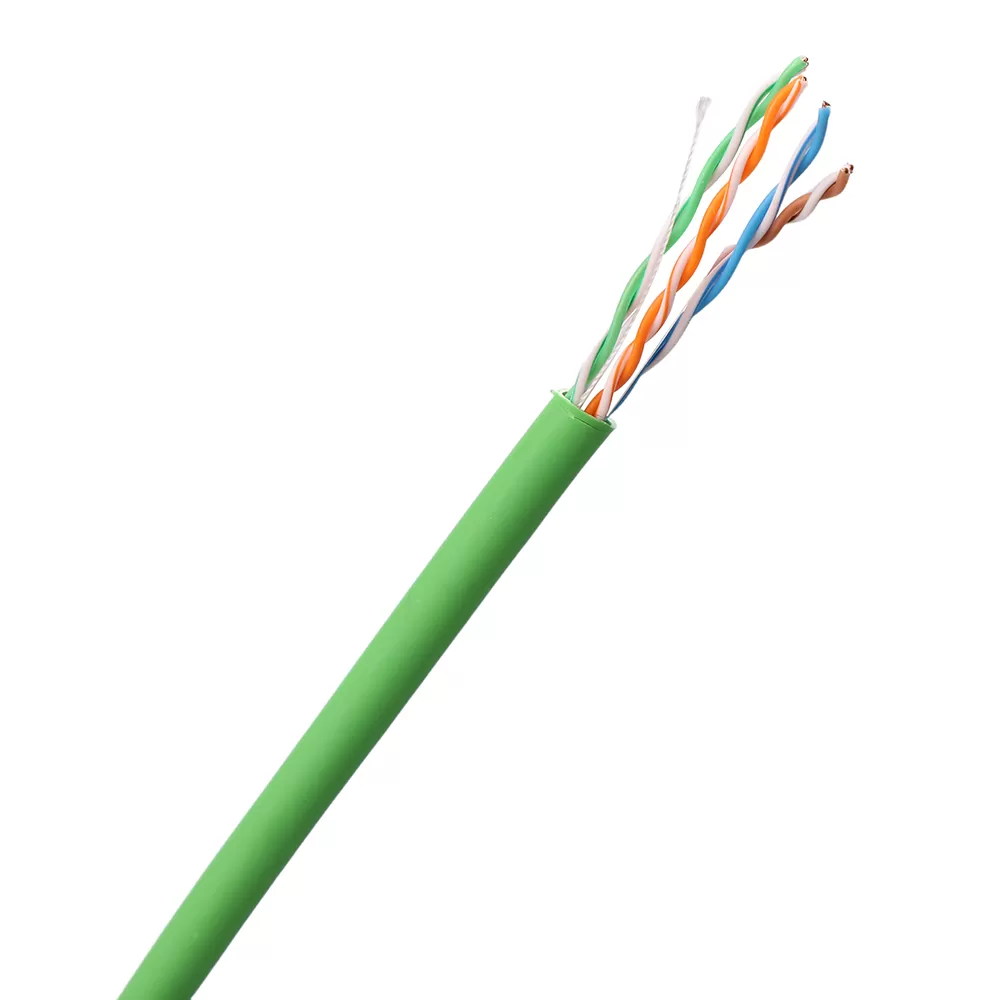
When comparing these two standards, several factors come to the forefront: speed, crosstalk, and bandwidth.
The most significant difference is the maximum data rate. Cat5 is limited to 100 Mbps, which is sufficient for basic web browsing but struggles with modern 4K streaming, large file transfers, and high-performance gaming. Cat5e, on the other hand, supports up to 1,000 Mbps (1 Gbps). This makes Cat5e the minimum requirement for any network utilizing a modern high-speed ISP plan.
Crosstalk occurs when the electrical signals from one wire pair interfere with the signals in another pair. Cat5e was specifically engineered to reduce Near-End Crosstalk (NEXT) and Power Sum Equal-Level Far-End Crosstalk (PS-ELFEXT). This reduction in interference is achieved through tighter twisting of the internal wire pairs and improved insulation. Xingfa's Cat5e solutions prioritize these manufacturing precision levels, ensuring that data packets arrive without corruption or the need for frequent retransmissions.
While both cables are rated for 100 MHz, Cat5e can handle a higher data load within that frequency.
| Feature | Cat5 (Category 5) | Cat5e (Category 5 Enhanced) |
| Max Data Speed | 100 Mbps | 1,000 Mbps (1 Gbps) |
| Frequency | 100 MHz | 100 MHz (with better performance) |
| Max Length | 100 Meters | 100 Meters |
| Crosstalk Level | High | Low (Enhanced suppression) |
| Standard Use | Legacy systems/Obsolete | Modern Home/Office Networks |
| PoE Support | Limited | Yes (Power over Ethernet) |
If you are currently using an older network, you might wonder if it’s worth replacing your existing Cat5 cables. The answer is almost always yes.
In a modern environment, using Cat5 acts as a bottleneck. Even if you have a 1 Gbps fiber connection coming into your building, if the cable connecting your router to your computer is a legacy Cat5 cable, your speed will be capped at 100 Mbps. Furthermore, Cat5e is better suited for Power over Ethernet (PoE) applications, such as powering IP security cameras or VoIP phones, because it handles electrical current with less heat buildup and signal degradation.
For businesses and installers, using high-quality materials is essential to avoid network downtime. Xingfa’s Cat5e data cable is manufactured with high-purity copper and durable jacketing, ensuring that the cable not only meets the Cat5e standard but exceeds it in terms of longevity and physical resilience.
One of the best features of the Cat5e standard is that it is fully backwards compatible. This means you can use a Cat5e cable in any device that previously used Cat5. The connectors (RJ45) are identical, and the cable will function perfectly with older switches, routers, and network interface cards. This makes upgrading an easy, plug-and-play process without needing to replace all your hardware at once.
While Cat5 was a pioneer in the networking world, it has been surpassed by the superior performance and reliability of Cat5e. In today’s data-heavy world, the enhanced features of Cat5e, higher speeds, reduced crosstalk, and better signal integrity, are no longer optional; they are a necessity.
Whether you are performing a simple home repair or a massive commercial installation, selecting a trusted manufacturer is key to network health. By choosing Xingfa’s Cat5e cable, you are investing in a product that bridges the gap between the legacy of Cat5 and the high-speed demands of the future. Don't let your wiring be the weak link in your digital life; upgrade to the enhanced standard.